China Top 10 Nebulizers How They Help Respiratory Patients?

Time:2026-09-25 Author:Madeline
0%

Choosing a nebulizer can feel confusing, especially when specifications, prices, and medical claims appear together. This guide introduces China’s top 10 nebulizers for respiratory patients, focusing on practical design, treatment support, and dependable operation. It considers compressor, ultrasonic, and mesh technologies, while explaining where each type may fit.

How nebulizers benefit respiratory patients depends on more than producing a visible mist. These devices convert prescribed liquid medicine into fine droplets that patients inhale through a mouthpiece or mask. For a child, the gentle mask and shorter treatment time may matter most. For an older adult, simple controls and stable airflow can be more valuable. The quiet hum beside a bedside table is also important during evening treatments.

Real-world use often reveals details that product pages overlook. A nebulizer should be easy to clean, comfortable to hold, and supported by clear instructions. It should also come from a manufacturer with appropriate quality systems and applicable medical-device certifications. However, no ranking can replace professional advice. Medication suitability, particle size, treatment duration, and breathing technique require clinical consideration. Not every model suits every patient.

This overview compares ten Chinese nebulizer brands and models through evidence-based criteria, including performance consistency, portability, noise, maintenance, and user feedback. Some conclusions remain conditional because independent testing and patient needs can differ. Readers should verify current certifications, warranty terms, and local approval requirements before purchasing. Use only medication prescribed by a qualified healthcare professional. Painfully practical, but necessary.
China Top 10 Nebulizers How They Help Respiratory Patients?

What Nebulizers Are and Why Respiratory Patients Use Them

A nebulizer is a device that turns liquid medicine into a fine mist. The patient breathes this mist through a mouthpiece or mask, usually while sitting upright. Unlike an inhaler, it does not require the same timed hand-and-breath coordination. That can make treatment easier for young children, some older adults, or people who struggle to inhale deeply. The mist may take several minutes to breathe in. Small detail, but it matters.

Respiratory patients may use nebulizers when a clinician prescribes inhaled medicine for conditions such as asthma or chronic lung disease. The device delivers medicine into the airways; it does not cure the underlying condition. A prescribed treatment plan should guide how often and how long to use it.

Not every cough needs a nebulizer.

After each session, cleaning the cup and mouthpiece as directed helps limit residue and contamination. Let parts dry fully before storing them. It is easy to assume more mist means more benefit, but changing a dose or treatment schedule without medical advice can be unsafe.

Even routine use can feel inconvenient, and cleaning steps are sometimes overlooked. Ask a healthcare professional to demonstrate the device and review its care instructions.

How Nebulizers Convert Medication into Breathable Mist

China Top 10 Nebulizers: How They Help Respiratory Patients?
How Nebulizers Convert Medication into Breathable Mist

A nebulizer turns liquid medicine into an aerosol that can be inhaled through a mouthpiece or mask. In a jet model, compressed air breaks liquid into tiny droplets. Mesh models push liquid through fine openings, while ultrasonic models use vibration. Tiny droplets matter. Aerosol science commonly identifies particles around 1–5 micrometers in diameter as respirable; the AARC’s Clinical Practice Guideline on Aerosol Delivery Devices discusses particle size and device selection. Actual lung delivery varies with breathing pattern, device design, and how well the mask fits.

The visible cloud is not the whole story. Some mist may remain in the cup, escape into the room, or settle around the mouth and nose. A calm, steady breathing pattern helps, but patients should follow their clinician’s instructions and the device manual. The process is simple in principle, yet delivery is not perfectly predictable. That detail deserves more attention than it often receives.

Tips: Sit upright, keep the medicine cup in its recommended position, and check that the mask seals comfortably. Clean and dry parts as instructed; leftover moisture can complicate routine care. If little or no mist appears, stop and check the setup rather than guessing.

Key Features Used to Compare China’s Top 10 Nebulizers

Comparing China’s top 10 nebulizers requires more than checking price or appearance. The key feature is aerosol particle size, usually measured as MMAD. Particles around 1–5 micrometres can reach the lower airways more effectively. Output rate also matters. A faster device may shorten treatment, but it can increase medication waste. Residual volume should remain low after each session. According to ISO 27427 guidance, performance testing should consider aerosol delivery, safety, and hygiene.

Noise, portability, and cleaning design strongly affect daily use. A quieter compressor may help children and older adults remain calm during treatment. Many users also value a lightweight body, a stable medicine cup, and simple controls. MarketsandMarkets estimated the global nebulizers market at about USD 1.2 billion in 2024, with continued growth expected through 2029. This demand reflects home treatment, but market growth does not guarantee equal clinical performance. A spreadsheet cannot fully measure comfort, mask fit, or real treatment habits.

Tips: Check particle-size data from independent tests, not only product claims. Confirm the device’s output rate, residual volume, noise level, and replacement-part availability. Clean the cup after every session and follow medical instructions. Some comparisons remain imperfect because testing methods differ. Ask a respiratory professional before changing prescribed treatment.

China Top 10 Nebulizers How They Help Respiratory Patients? - Key Features Used to Compare China’s Top 10 Nebulizers

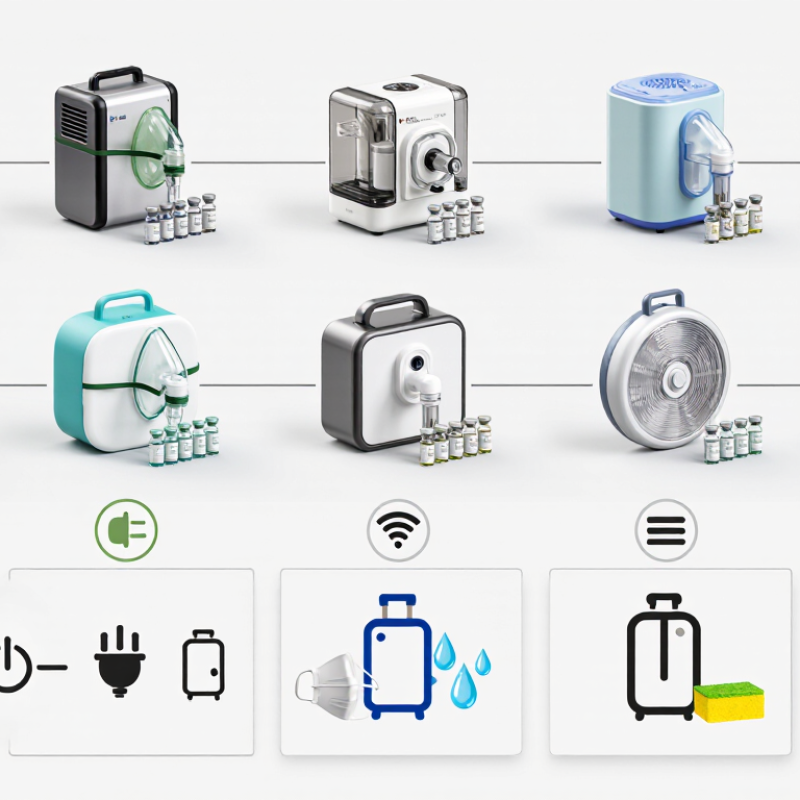
This comparison describes ten common nebulizer configurations available in the market, rather than a verified sales ranking or a list of specific products. It focuses on how each design may support prescribed inhaled treatment and on practical differences for patients and caregivers.

Comparison of common nebulizer types and patient-use features
No. Nebulizer configuration How it generates aerosol Typical portability and power Aerosol-size consideration How it may help respiratory patients Key limitation to check
1 Tabletop compressor jet nebulizer Compressed air passes through a liquid medication chamber to create an aerosol. Usually mains-powered; intended mainly for home or clinic use. Many systems are designed to produce droplets in a respirable range; actual size depends on the device and medication. A familiar option for delivering prescribed aerosol medicines, including many solutions and some suspensions when the device instructions allow. Typically louder and less portable than mesh devices; tubing and the medication cup need regular cleaning.
2 Compact compressor jet nebulizer Uses the same compressed-air jet principle in a smaller housing. Generally mains-powered and easier to store or move than a larger tabletop unit. Check the specific model’s particle-size data; compact size alone does not establish aerosol performance. Can provide a home-treatment option where a standard compressor system is prescribed but storage space is limited. Still requires a power source, tubing and cleaning; treatment time varies by device and fill volume.
3 Pediatric compressor nebulizer with mask A compressor drives air through a jet chamber; a child-sized mask helps deliver aerosol during normal breathing. Usually mains-powered and used with caregiver supervision. Particle size is determined by the nebulizer chamber and formulation, not by the mask size. A properly fitted mask can make prescribed treatment more practical for young children who cannot reliably use a mouthpiece. A poor mask seal can reduce the amount inhaled. The mask and accessories must fit the child and be cleaned as directed.
4 Vibrating-mesh nebulizer A vibrating perforated membrane pushes liquid through small openings to form aerosol. Often compact; power may be supplied by a battery or external source, depending on the unit. Droplet characteristics vary by membrane and medication; follow the device’s stated performance information. Quiet operation and compact construction may make prescribed treatments easier to use at home or while travelling. Not every medicine is compatible. Viscous liquids or suspensions may be unsuitable unless the instructions specifically permit them; the mesh needs careful cleaning.
5 Portable battery-powered mesh nebulizer Uses a vibrating mesh to create aerosol from the medication solution. Designed for mobile use; battery life and charging method are model-dependent. Performance should be checked in the device instructions for the prescribed formulation. May help patients follow a prescribed treatment schedule when away from a fixed power outlet. Battery condition, correct assembly and careful cleaning matter; portability does not mean every medication can be used in it.
6 Mesh nebulizer with interchangeable mouthpiece and mask A vibrating mesh generates aerosol, which is inhaled through a mouthpiece or suitable mask. Often portable; power arrangement depends on the design. Aerosol output and size are device-specific and may change with the formulation. Accessory choice can accommodate different ages or patient ability, subject to clinical advice and proper fit. Accessories must be assembled and cleaned correctly. A mask may deliver less efficiently than a well-used mouthpiece in some circumstances.
7 Tabletop ultrasonic nebulizer High-frequency vibration creates aerosol from liquid in the chamber. Usually intended for stationary use and powered from an electrical outlet. Droplet characteristics vary by model; confirm suitability for the specific prescribed medicine. Can aerosolize compatible liquid formulations without the compressed-air noise of many jet systems. Ultrasonic devices may warm the liquid and are not suitable for some suspensions or heat-sensitive medicines. Check the medicine and device instructions.
8 Portable ultrasonic nebulizer Uses ultrasonic vibration to produce aerosol from compatible liquids. Some designs are compact or battery-operated; power arrangements vary. Use only with formulations approved for that specific device. Its compact format may make treatments easier to arrange outside the home when the medicine is compatible. Medication compatibility is a key concern; portability does not make it suitable for all inhaled medicines.
9 Breath-enhanced jet nebulizer A jet system adds or entrains airflow during inhalation to improve aerosol delivery compared with a basic continuous-output design. Generally used with a compressor and is less portable than many mesh units. Actual particle size and delivered dose depend on the particular chamber and breathing pattern. Breath-enhanced designs can reduce aerosol lost during exhalation compared with some basic continuous-output systems. Correct breathing technique and compatibility with the prescribed medicine remain important; the system still needs a compressor.
10 Breath-actuated jet nebulizer A valve or mechanism releases aerosol primarily during inhalation. Typically paired with a compressor; setup and operating method vary by design. Refer to the device’s own performance data and medicine instructions. Timed aerosol delivery may reduce medication wasted into the surrounding air during exhalation. Some patients may find the breathing coordination or operating requirements challenging; suitability should be assessed by a healthcare professional.

Important: Nebulizers deliver medication as an inhalable mist; they do not treat the underlying cause of every respiratory condition. Particle size, output rate, treatment time and medicine compatibility vary by device and formulation. Use only medicines prescribed for nebulization, follow the manufacturer’s instructions, and ask a healthcare professional which device and accessories are appropriate.

How Different Nebulizer Types Support Respiratory Treatment

China Top 10 Nebulizers: How They Help Respiratory Patients?

How Different Nebulizer Types Support Respiratory Treatment

Nebulizers turn prescribed liquid medicine into a breathable mist. This can help patients who struggle with inhalers, including some children, older adults, and people during severe breathlessness. Treatment still requires medical guidance. A nebulizer is not a replacement for diagnosis or emergency care.

Jet nebulizers use compressed air to create the mist. They are widely used and can handle many medication solutions, but their compressors may sound like a small motor. Treatment can also take ten minutes or longer. Ultrasonic nebulizers operate more quietly and often deliver mist faster. However, heat or vibration may affect certain medicines. Always check the medicine instructions.

Mesh nebulizers push liquid through a fine vibrating membrane. They are usually compact, which helps during travel or bedside treatment. Their small openings can clog when cleaning is incomplete. Portable devices may also depend on batteries, creating problems during long treatment sessions. A respiratory therapist can match the nebulizer type with the patient’s medicine, breathing ability, and daily routine. A practical detail matters: the mask should fit gently around the nose and mouth, without obvious leaks.

The “best” device is not universal. I would question any ranking that ignores medicine compatibility and cleaning habits. Wash detachable parts as directed, let them dry fully, and replace worn components on schedule. Small errors can reduce the delivered dose.

China Top 10 Nebulizers: How They Help Respiratory Patients

How Different Nebulizer Types Support Respiratory Treatment

Aerosol particle size strongly influences where medication is deposited in the respiratory tract. Particles around 1–5 micrometres (µm) are commonly used to support delivery to the lower airways, although actual performance depends on the device, medication, breathing pattern, and treatment settings.

The values shown are representative midpoints from commonly reported clinical ranges, not brand specifications. Actual particle size and output can vary by model and medication formulation.

Safety, Maintenance, and Patient Selection Guidelines

China’s top 10 nebulizers should be judged by safety and clinical suitability, not popularity alone. A healthcare professional should match the device with the prescribed medicine, patient age, breathing ability, and treatment frequency. Children may need a stable mask, while adults often prefer a mouthpiece. A compact unit helps during travel, but portability must not reduce treatment reliability. A quiet machine is not automatically better.

Safety comes first. Keep the patient seated upright, and use the nebulizer in a clean, well-ventilated area. Do not share masks or mouthpieces. Wash detachable parts after each treatment, then let them air-dry completely. Never place the compressor in water. Check tubing, filters, and medication cups for cracks or blockage. Follow the instruction manual for replacement intervals. Small defects can affect medicine delivery. Many users overlook this.

Tips: Confirm the prescribed dose before every session. Keep the device away from children’s reach when unused. Replace damaged parts promptly. Record unusual coughing, dizziness, or worsening breathlessness, and contact a qualified clinician. Emergency symptoms require urgent medical attention, not repeated self-treatment. Selection is not always perfect; a device that works well for one patient may frustrate another. Review comfort, treatment time, cleaning habits, and observed performance regularly.

FAQS

What does a nebulizer do?

It turns prescribed liquid medicine into a fine mist for breathing through a mask or mouthpiece. Sessions can take several minutes.

Who may find a nebulizer easier to use than an inhaler?

Young children, some older adults, and people who struggle with timed breathing may find it easier. The device still needs to match their treatment plan.

Does a nebulizer cure asthma or chronic lung disease?

No. It delivers prescribed medicine to the airways but does not cure the underlying condition. Not every cough needs nebulizer treatment.

What features matter when comparing nebulizers?

Check particle-size data, output rate, residual medicine, noise, and cleaning design. A quiet machine is not automatically better.

Why does residual volume matter?

It is the medicine left in the cup after treatment. Lower residual volume may mean less medicine remains unused, but device performance varies.

How should users clean a nebulizer after treatment?

Wash detachable parts as directed, then let them air-dry fully before storage. Do not put the compressor in water. Easy to overlook.

Can family members share a mask or mouthpiece?

No. Do not share masks or mouthpieces. Check the tubing, filters, and medicine cup for cracks or blockages.

When should a user contact a healthcare professional?

Ask for help matching the device to the prescribed medicine and patient’s needs. Contact a qualified clinician about unusual coughing, dizziness, or worsening breathlessness. Emergency symptoms need urgent medical attention.

Conclusion

Nebulizers are medical devices that help respiratory patients receive prescribed medication through a fine, breathable mist. By using compressed air, ultrasonic vibration, or a vibrating mesh, they transform liquid medicine into tiny particles that can reach the airways more easily. This makes nebulizer therapy useful for people who have difficulty using inhalers, including children, older adults, and patients experiencing breathing challenges. Understanding how nebulizers benefit respiratory patients involves considering their delivery efficiency, treatment comfort, noise level, portability, power options, particle size, and ease of operation.

Different nebulizer types may suit different treatment needs and living situations. Compressor models are often dependable, while mesh and ultrasonic systems may offer quieter and more convenient operation. Safe use requires following medical instructions, using the correct medication dosage, cleaning components after each treatment, and replacing worn parts promptly. Patients should select a device with guidance from a healthcare professional, especially when treating asthma, chronic lung conditions, or respiratory infections. Proper maintenance and responsible use can support effective therapy and reduce contamination risks.

Madeline

Madeline

Madeline is a dedicated marketing professional with a wealth of expertise in our company's core offerings. With a keen understanding of the industry, she brings a unique perspective to her role, consistently delivering high-quality content that highlights the superior aspects of our products. As......